Somewhere with Clinton Omondi
June 12, 2026 2026-06-16 13:36
Somewhere with Clinton Omondi
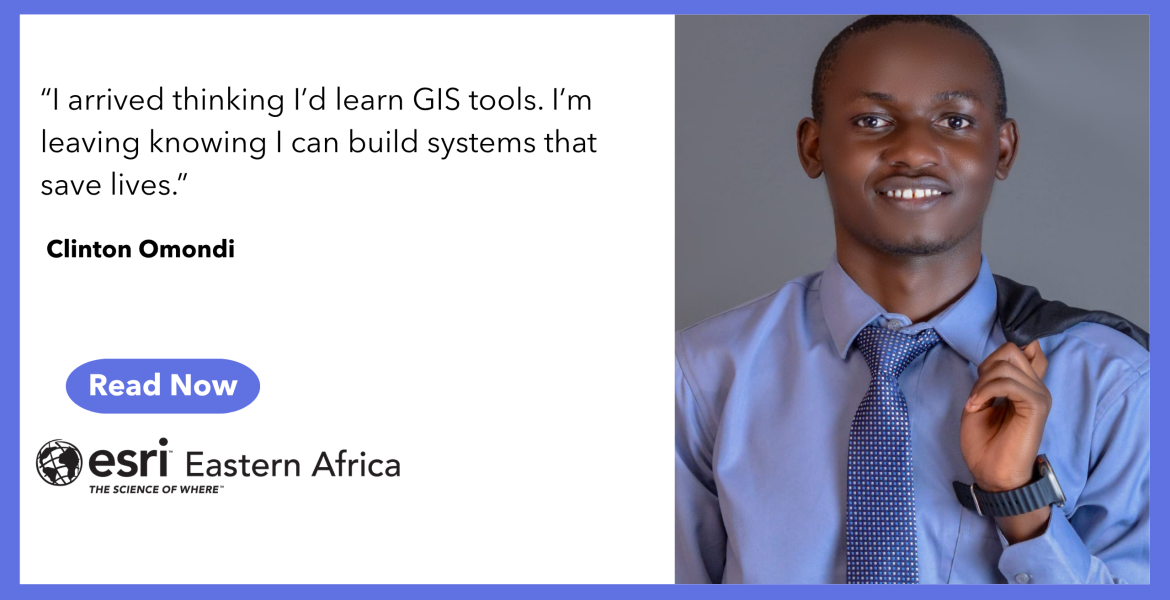
Clinton Omondi is a geospatial engineer working across GIS, data science and full-stack development. He builds end-to-end systems that combine spatial analysis, machine learning and web applications using tools such as Python, Django, PostgreSQL/PostGIS, Node.js and React.
Alongside his technical work, he mentors students in programming and data analysis and has also expressed an interest in mental and community well-being. In this Q&A, Clinton reflects on his time at Esri Eastern Africa, the skills he developed and his work during that period.
Q: What is the most impactful skill or concept you gained during the internship?
The most impactful skill I gained was spatial problem-solving using multi-criteria decision analysis. Before this internship, I understood GIS as a tool for making maps. Now I see it as a way of breaking down complex problems into measurable parts that can be analysed and acted on. A problem like Nairobi’s ambulance response can be translated into spatial criteria such as population density, road access, hospital proximity and emergency hotspots. Working through weighted overlay analysis showed how these factors can be combined into clear, defensible outputs. Beyond the analysis, I also learned how to build full-stack spatial applications, connecting ArcGIS Online to React-based interfaces and creating systems that move from analysis to use.
Q: Which ArcGIS tool or workflow did you enjoy working with the most and why?
ArcGIS Online Feature Services and the REST API stood out the most, though not immediately. It wasn’t easy at first, publishing layers, managing permissions and debugging API calls felt complex and fragmented. It became clearer once I understood Feature Services as the bridge between GIS analysis and applications. I could run spatial analysis in ArcGIS Pro, publish the results to ArcGIS Online and then query the data from my React applications using HTTP requests. The turning point was seeing an emergency request submitted from a citizen app appear instantly on the dispatch map. From that point, it was clear the system was not just storing data — it was moving it.
I also appreciated the flexibility. The same Feature Service could support dashboards, Survey123 and custom applications, all without changing the core dataset. It was an elegant infrastructure that scales effortlessly.
Q: Looking back, how would you sum up your internship experience in one word or sentence and why?
Transformative. I didn’t just learn new tools, I changed how I approach problems. I started with the intention of learning GIS software. I’m leaving with the ability to think in systems.
I learned that usefulness matters more than complexity. That coordination can matter more than resources. And that analysis only matters when it connects to action. I also learned that technical work is incomplete without understanding the people using it. Much of that came from everyday interactions and problem-solving sessions with the Esri team — not just from structured training. That combination shaped how I now think about my work.
Q: What is something memorable from your internship at Esri Eastern Africa?
The daily tea breaks. Not because of the tea, but because of the conversations. That is where I learned about work happening across different industries — utilities, government, commercial and natural resources. It gave a clearer sense of how GIS is used across different contexts and how similar spatial thinking connects them.
Q: Tell us about your final project. What were you working on and what problem were you trying to solve?
Nairobi Emergency Medical Services (EMS) Coordination System.
Nairobi has around 150–200 ambulances, yet average emergency response times remain above 35 minutes — beyond the critical 8–15 minute window. The challenge is coordination, not only availability. Ambulances operate without a central system. Dispatch decisions rely on phone calls and citizens often contact multiple numbers to access help. There is no real-time view of system performance. The result is delays in response when time matters most.
My project focused on improving how existing emergency resources are coordinated using GIS through a Citizen Request App for submitting emergencies with GPS location, a dispatch console for real-time ambulance assignment and tracking, a paramedic field app for navigation and status updates and a management dashboard for monitoring response performance.
On the analytical side, I used multi-criteria decision analysis to identify optimal dispatch centre locations based on population density, road access, hospital proximity and emergency concentration areas. The analysis identified 12 dispatch centres across Nairobi to improve ambulance coverage and response coordination. I also developed a hospital routing model, evaluating 143 hospitals based on distance, capacity, ICU availability and service capability.
The system was built using ArcGIS Pro, ArcGIS Online and custom applications. The outcome was a coordinated structure showing how existing resources could be used more effectively through better information flow.
Q: What advice would you give to future interns considering the Esri Eastern Africa internship program?
Come with a real problem, not just an interest in tools. The strongest work comes from trying to solve something specific, not experimenting for its own sake. Ask precise questions. Show what you’ve already attempted and where you are stuck. The support is there, but clarity matters. Expect things to break. Networks fail. APIs return errors. Services refuse to publish. That is part of the process. Don’t isolate yourself. Conversations with the team matter as much as the work itself. Be intentional about what you build. Treat every project as something that will be shown beyond the internship.
What you take from the experience depends on what you choose to build with it. The experience is what you make of it. Use the opportunity to learn, build, and create something meaningful.
Interested in joining the Esri Eastern Africa internship program? Send your CV to careers@esriea.com and keep an eye on our social channels for upcoming opportunities and intern stories like this one.